


















































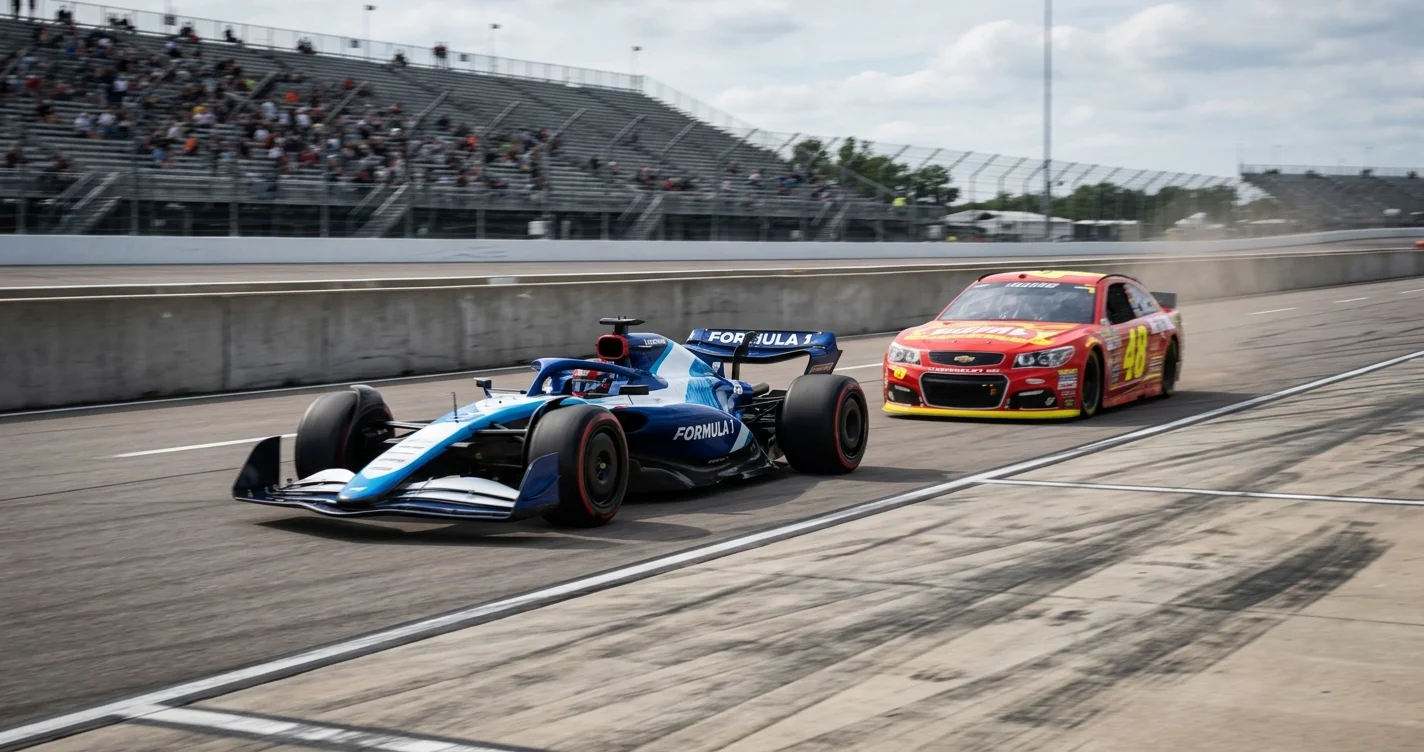
Formula 1 Faster Than NASCAR – When motorsport enthusiasts gather around the world, one debate inevitably emerges: which racing series truly represents the pinnacle of speed? The question “Is Formula 1 faster than NASCAR?” sparks passionate discussions from the cafés of Monaco to the infields of Daytona. While both series showcase incredible engineering prowess and driver skill, the answer isn’t as straightforward as you might think.
The fascination with speed comparison between these two racing titans reflects our deeper curiosity about what makes one racing machine superior to another. Formula 1, with its precision-engineered open-wheel cars navigating complex circuits, represents the technological zenith of motorsport. Meanwhile, NASCAR’s stock cars, thundering around oval tracks at breathtaking speeds, embody raw power and wheel-to-wheel racing excitement.
Understanding the speed dynamics between F1 and NASCAR requires diving deep into the technical specifications, track layouts, racing philosophies, and performance metrics that define each series. The reality involves much more than simple top speed comparisons – it encompasses acceleration, cornering speeds, braking capabilities, and the overall racing package that determines which cars truly dominate their respective domains.
This comprehensive analysis will explore every aspect of the F1 versus NASCAR speed debate, examining the engineering marvels behind each series, the tracks that test their limits, and the measurable performance data that reveals the truth about which racing formula delivers the ultimate speed experience.
Table of Contents
Understanding the Fundamental Differences Between F1 and NASCAR
The speed comparison between Formula 1 and NASCAR begins with understanding their fundamental design philosophies and racing objectives. These two series represent completely different approaches to motorsport excellence, each optimized for specific racing conditions and performance goals.
Formula 1 cars are purpose-built, single-seat racing machines designed for maximum performance on road courses featuring a mix of straights, corners, elevation changes, and varying track surfaces. Every component from the carbon fiber monocoque chassis to the hybrid power units reflects decades of technological advancement aimed at achieving the perfect balance of speed, handling, and efficiency. F1 regulations permit sophisticated aerodynamic packages, advanced suspension systems, and cutting-edge materials that push the boundaries of automotive engineering.
NASCAR vehicles, despite being called "stock cars," are highly specialized racing machines built around a common chassis specification known as the Next Gen car. These vehicles prioritize durability, close racing, and performance on oval tracks where sustained high speeds and precise handling in traffic become paramount. While they share visual similarities with production cars, NASCAR racers feature tube frame construction, purpose-built racing engines, and aerodynamic packages specifically tuned for oval track racing dynamics.
The regulatory environments governing each series fundamentally shape their speed characteristics. Formula 1 operates under complex technical regulations that encourage innovation while maintaining safety standards. Teams invest hundreds of millions of dollars developing unique solutions for aerodynamics, power units, and chassis design. This freedom to innovate results in cars that excel at different aspects of performance depending on each team's development focus and budget.
NASCAR employs a more restrictive approach, using common chassis specifications and standardized components to ensure competitive parity. This philosophy creates closer racing but limits the technological differentiation seen in Formula 1. The emphasis shifts from pure technological advancement to setup optimization, driver skill, and race strategy within tightly controlled parameters.
These philosophical differences extend to the tracks themselves. Formula 1 circuits challenge cars with diverse layouts featuring tight hairpins, sweeping curves, long straights, and elevation changes. Each track demands different performance characteristics, requiring teams to develop versatile machines capable of adapting to various racing conditions. NASCAR primarily focuses on oval tracks where sustained high speeds, aerodynamic efficiency in traffic, and handling stability become the primary performance factors.
Technical Specifications: Power, Weight, and Engineering Excellence
The heart of any speed comparison lies in examining the technical specifications that determine performance capabilities. Formula 1 and NASCAR represent different approaches to extracting maximum performance from their respective racing packages, with each series optimizing for specific performance characteristics.
Modern Formula 1 cars utilize sophisticated hybrid power units combining 1.6-liter turbocharged V6 internal combustion engines with advanced Energy Recovery Systems (ERS). The total power output reaches approximately 1000 horsepower when combining the ICE and electric motor contributions. This power drives cars weighing around 798 kilograms (including the driver), resulting in an exceptional power-to-weight ratio of roughly 1.25 horsepower per kilogram.
The hybrid technology in Formula 1 provides both performance and efficiency benefits. The ERS-K system recovers kinetic energy during braking and redeploys it for additional power, while the ERS-H system harvests energy from exhaust gases via the turbocharger's motor-generator unit. This sophisticated energy management allows F1 cars to deliver consistent performance while meeting strict fuel flow limitations and promoting technological advancement relevant to road car development.
NASCAR Cup Series cars employ naturally aspirated 5.86-liter V8 engines producing approximately 670 horsepower. These engines prioritize reliability and consistency over peak power output, reflecting the demands of 500-mile races where durability becomes as important as speed. The complete NASCAR package weighs approximately 1,542 kilograms, resulting in a power-to-weight ratio of about 0.43 horsepower per kilogram – significantly lower than Formula 1 but optimized for different racing requirements.
The weight distribution and chassis design philosophies differ dramatically between the series. Formula 1 cars feature carbon fiber monocoque construction that provides exceptional rigidity while minimizing weight. Every component undergoes intensive optimization to reduce mass without compromising safety or performance. The resulting vehicles feel more responsive to driver inputs and demonstrate superior acceleration and braking capabilities.
NASCAR's tube-frame construction prioritizes durability and safety in the high-speed, close proximity racing environment typical of oval tracks. The additional weight helps maintain stability at sustained high speeds and provides better handling predictability when racing in large groups. While this approach sacrifices some acceleration performance, it delivers the consistency and reliability essential for endurance racing on oval circuits.
Aerodynamic packages represent another crucial technical difference. Formula 1 cars generate enormous amounts of downforce through sophisticated front and rear wings, floor designs, and bodywork optimization. This aerodynamic grip allows F1 cars to maintain incredible speeds through corners while providing the stability needed for precise handling. The downforce levels can exceed the car's weight at high speeds, theoretically allowing them to drive upside down in a tunnel.
NASCAR aerodynamics focus on reducing drag for maximum straight-line speed while generating sufficient downforce for stability in traffic. The aerodynamic packages undergo careful balancing to promote close racing without creating handling characteristics that make passing impossible. Recent NASCAR technical developments have emphasized "dirty air" reduction, allowing cars to follow more closely and increasing overtaking opportunities.
Track Design Impact: Where Each Series Excels
The fundamental differences in track layouts between Formula 1 and NASCAR significantly influence speed comparisons and performance characteristics. Understanding how each series optimizes for their respective racing environments reveals why direct speed comparisons often miss the bigger picture of racing performance excellence.
Formula 1 circuits showcase incredible diversity, ranging from the tight confines of Monaco's street circuit to the high-speed challenges of Monza's historic layout. This variety demands cars capable of excelling across dramatically different performance requirements. At Monaco, average speeds hover around 160 kilometers per hour due to the circuit's narrow, twisting layout with numerous 90-degree corners and elevation changes. Conversely, Monza's long straights and sweeping curves allow F1 cars to demonstrate their maximum speed potential, with average lap speeds exceeding 250 kilometers per hour.
The technical demands of F1 circuits extend beyond simple speed requirements. Tracks like Suzuka in Japan combine high-speed sections with technical corner sequences that test every aspect of car performance. The famous 130R corner challenges drivers and machines with sustained high-g cornering forces, while the chicane sequences demand rapid direction changes and precise handling. This diversity ensures that Formula 1 cars must excel at acceleration, top speed, cornering performance, and braking – a complete performance package that sets them apart from more specialized racing machines.
NASCAR's oval track focus creates entirely different performance priorities. Superspeedways like Daytona and Talladega allow NASCAR cars to demonstrate their impressive top speed capabilities, with qualifying speeds regularly exceeding 200 miles per hour. These tracks feature long straights and sweeping, banked turns that enable sustained high speeds throughout the lap. The banking helps maintain momentum through corners, allowing drivers to carry more speed than would be possible on flat surfaces.
The technical challenges of oval racing often get overlooked by casual observers. Maintaining 180+ mile per hour speeds for 500 miles requires exceptional mechanical reliability, aerodynamic efficiency, and handling balance. Small setup changes can dramatically affect a car's ability to handle in traffic, where aerodynamic disturbances from other vehicles create handling challenges that don't exist in solo qualifying runs. The art of oval racing involves managing these aerodynamic effects while maintaining competitive speeds lap after lap.
Intermediate tracks like Charlotte Motor Speedway and Las Vegas Motor Speedway present different challenges, combining relatively high speeds with more technical handling requirements. These 1.5-mile tracks require cars that can generate speed on the straights while maintaining control through the corners, often without the extreme banking found at superspeedways. The handling balance becomes more critical as drivers must manage cornering speeds while preserving tire performance over long racing distances.
Road course events in NASCAR, such as the race at Circuit of the Americas, provide direct comparison opportunities between the series. When NASCAR cars tackle road courses, their lap times typically fall significantly behind comparable Formula 1 performances due to the optimization differences in suspension, aerodynamics, and power delivery characteristics. However, these comparisons highlight each series' specialization rather than indicating overall superiority.
Formula Racing Live: Real-World Speed Measurements
Analyzing actual performance data from formula racing live events and NASCAR competitions provides concrete evidence for speed comparisons. The measurable performance metrics reveal how each series excels in different aspects of racing performance, offering insights that go beyond theoretical specifications to examine real-world capabilities.
Top speed measurements showcase one area where NASCAR demonstrates clear advantages on appropriate tracks. At superspeedways, NASCAR Cup Series cars regularly exceed 200 miles per hour during qualifying sessions, with the current Talladega Superspeedway qualifying record standing at 212.809 mph, set by Bill Elliott in 1987. Modern NASCAR cars, while slightly slower due to aerodynamic restrictions implemented for safety reasons, still achieve qualifying speeds approaching 200 mph at these venues.
Formula 1's top speed capabilities depend heavily on track layout and aerodynamic configuration. At Monza, which features the longest straights on the F1 calendar, cars routinely reach speeds exceeding 350 kilometers per hour (217 mph) during races. The 2020 Italian Grand Prix saw Lewis Hamilton's Mercedes reach 358.4 km/h (222.7 mph) during the race, demonstrating F1's impressive straight-line capability despite the cars' high-downforce aerodynamic packages.
However, these peak speeds only tell part of the performance story. Average lap speeds provide more meaningful insights into overall performance capabilities. Formula 1's Monaco Grand Prix, with its tight street circuit layout, produces average qualifying lap speeds around 160 km/h (99 mph). In contrast, the Hungarian Grand Prix at the similarly technical Hungaroring circuit sees average qualifying speeds approaching 190 km/h (118 mph), showcasing how track layout dramatically influences speed comparisons.
NASCAR's oval track specialization becomes evident when examining average lap speeds. At Daytona International Speedway, NASCAR Cup Series cars maintain average racing speeds around 180-190 mph throughout 500-mile events. This sustained high-speed performance over extended distances demonstrates the remarkable consistency and aerodynamic efficiency of the NASCAR package. The ability to maintain these speeds while racing in close proximity to other vehicles adds another layer of complexity to the performance equation.
Acceleration measurements reveal Formula 1's significant advantages in lower-speed performance scenarios. F1 cars accelerate from 0-100 km/h (62 mph) in approximately 2.6 seconds, compared to NASCAR's roughly 3.4 seconds for the same benchmark. This acceleration advantage extends through higher speed ranges, with F1 cars reaching 200 km/h nearly 2 seconds faster than their NASCAR counterparts. The superior power-to-weight ratio and advanced traction control systems contribute to this acceleration dominance.
Braking performance represents another area where Formula 1 demonstrates clear superiority. F1 cars can decelerate from 200 km/h to complete stops in distances under 100 meters, generating deceleration forces exceeding 5 g's. Carbon-carbon brake discs, advanced brake-by-wire systems, and sophisticated aerodynamic braking assistance enable these remarkable stopping capabilities. NASCAR cars, while featuring powerful braking systems, cannot match these deceleration rates due to their higher weight and different brake technology optimization.
Cornering speed data provides fascinating insights into each series' strengths. Formula 1 cars generate cornering forces exceeding 5 g's in high-speed turns, allowing them to maintain speeds that would be impossible for other racing vehicles. The combination of aerodynamic downforce, advanced suspension systems, and specialized tire compounds enables F1 cars to negotiate complex corner sequences at speeds that challenge human physiological limits.
NASCAR's cornering performance optimization focuses on consistency and handling balance rather than peak cornering forces. The cars generate substantial grip through mechanical setup and aerodynamic balance, but the emphasis remains on predictable handling characteristics that allow close racing rather than maximum cornering speed. This approach produces exciting wheel-to-wheel competition while maintaining safety margins appropriate for oval track racing.
Formula Racing News: Recent Performance Developments and Innovations
Recent developments in formula racing news highlight the continuous evolution of speed and performance in both Formula 1 and NASCAR. These technological advances and regulatory changes directly impact the speed comparison discussion while showcasing each series' commitment to pushing performance boundaries within their respective racing philosophies.
The 2022 Formula 1 season introduced dramatic aerodynamic regulation changes designed to improve racing while maintaining high performance standards. The new technical regulations simplified front wing designs, introduced ground effect aerodynamics, and modified rear wing specifications to reduce the aerodynamic disturbance that following cars experience. These changes initially reduced peak downforce levels but created more efficient aerodynamic packages that maintain speed while improving wheel-to-wheel racing opportunities.
Early analysis of the 2022 F1 regulation changes revealed fascinating speed implications. While peak downforce decreased by approximately 10-15% compared to previous regulations, the cars maintained competitive lap times through improved aerodynamic efficiency and better tire performance. The ground effect aerodynamics generate downforce more efficiently than previous wing-dependent designs, allowing teams to run lower drag configurations without sacrificing cornering performance significantly.
Mercedes, Red Bull Racing, and Ferrari have demonstrated different approaches to maximizing performance under the new regulations. Red Bull's RB19 showcased exceptional efficiency at high-speed circuits like Monza, where Max Verstappen achieved qualifying speeds exceeding 350 km/h while maintaining competitive cornering performance. Mercedes focused on developing consistent performance across various track types, while Ferrari emphasized peak performance that proved particularly effective at circuits demanding high aerodynamic efficiency.
NASCAR's Next Gen car introduction in 2022 represented the most significant technical evolution in decades for the series. The new platform features independent rear suspension, larger wheels with lower-profile tires, improved aerodynamic packages, and enhanced safety systems. These changes fundamentally altered the speed characteristics and racing dynamics of NASCAR competition while maintaining the close, competitive racing that defines the series.
Performance data from the Next Gen car's debut season revealed interesting speed implications. The new suspension systems improved handling consistency and driver comfort while maintaining the speed capabilities that make NASCAR exciting. At superspeedway events, the aerodynamic modifications created tighter pack racing with more frequent position changes, demonstrating how technical evolution can enhance racing quality without necessarily increasing peak speeds.
The tire technology evolution in both series continues influencing speed capabilities. Pirelli's Formula 1 tire development focuses on compounds that provide consistent performance across varying track conditions while maintaining safety margins under extreme cornering loads. The 18-inch wheel transition in 2022 required completely new tire construction approaches that initially reduced peak grip levels but improved consistency and road car relevance.
NASCAR's tire development with Goodyear emphasizes durability and consistent performance over 500-mile races. Recent innovations include compounds designed to provide multiple grip levels throughout tire wear cycles, creating strategic opportunities while maintaining safety standards. The larger wheels on Next Gen cars required new tire construction techniques that improved handling precision while maintaining the tire wear characteristics essential for strategic racing.
Hybrid technology developments continue shaping Formula 1's performance evolution. The current power unit regulations run through 2025, but discussions about future power unit specifications focus on increased electrical power integration and sustainable fuel adoption. These developments could fundamentally alter the speed equation by providing different power delivery characteristics and efficiency requirements.
Engine development in NASCAR has focused on reliability and cost control rather than peak power increases. The sealed engine program ensures competitive parity while reducing development costs, allowing teams to focus resources on aerodynamics, chassis setup, and race strategy. Recent technical bulletins have addressed minor performance adjustments to maintain competitive balance across different manufacturers.
Safety innovations in both series influence speed capabilities through regulatory constraints and technological improvements. Formula 1's Halo device introduction initially raised concerns about aerodynamic disruption, but teams quickly adapted their designs to maintain performance levels while significantly improving driver protection. Similarly, NASCAR's enhanced roll cage specifications and impact-absorbing materials provide better safety margins without substantially limiting speed potential.
Cornering Speeds and Handling: Technical Performance Analysis
The most revealing performance differences between Formula 1 and NASCAR emerge when examining cornering speeds and handling capabilities. These measurements showcase each series' optimization priorities and reveal why simple top speed comparisons fail to capture the complete performance picture.
Formula 1's cornering performance represents the pinnacle of racing car technology applied to road course racing. Modern F1 cars generate peak cornering forces exceeding 5 g's in high-speed turns, allowing them to maintain speeds through corners that would challenge the structural limits of other racing vehicles. The famous Copse corner at Silverstone, taken at speeds approaching 290 km/h, demonstrates the incredible cornering capabilities that separate F1 from other racing series.
The technical systems enabling these cornering speeds include sophisticated aerodynamic packages generating over 1000 kilograms of downforce at racing speeds. This aerodynamic grip, combined with mechanical grip from advanced tire compounds and suspension systems, creates cornering capabilities that exceed most other racing vehicles.
Conclusion: The Verdict on Formula 1 vs NASCAR Speed Supremacy
After examining every aspect of the Formula 1 versus NASCAR speed debate, the answer to "Is Formula 1 faster than NASCAR?" reveals itself to be beautifully complex. The truth transcends simple speed measurements and encompasses the fundamental philosophies that define each racing series.
Formula 1 demonstrates clear superiority in overall speed versatility, acceleration, braking performance, and cornering capabilities. F1 cars excel across diverse performance metrics that matter for road course racing, from their incredible 0-100 km/h acceleration times of 2.6 seconds to their ability to generate over 5 g's of cornering force. The sophisticated hybrid power units, advanced aerodynamics, and cutting-edge materials create racing machines that represent the absolute pinnacle of automotive technology. When examining formula racing live events and formula racing news, the consistent performance evolution showcases engineering excellence that pushes the boundaries of what's physically possible in motorsport.
However, NASCAR's specialized excellence on oval tracks cannot be dismissed. The sustained 180+ mph speeds over 500-mile distances, the ability to race wheel-to-wheel at 200 mph, and the remarkable consistency required for superspeedway competition represent different but equally impressive achievements. NASCAR's approach prioritizes durability, close racing, and spectacle over pure technological advancement, creating a product that excels within its specific domain.
The real victory lies in recognizing that both series achieve speed excellence through different paths. Formula 1 pushes technological boundaries to create the ultimate road course racing machine, while NASCAR optimizes for sustained high-speed performance and competitive racing on oval tracks. Each series delivers exactly what its format demands: F1 provides technological showcase and versatile performance, while NASCAR offers thrilling pack racing and incredible speed consistency.
For racing enthusiasts seeking to understand these magnificent machines, the speed comparison reveals the beauty of motorsport diversity. Formula 1 and NASCAR each represent perfected approaches to their respective racing challenges, creating two distinct but equally valid expressions of speed, engineering excellence, and competitive racing.
The next time someone asks whether Formula 1 is faster than NASCAR, the informed answer acknowledges both series' achievements while recognizing that true racing excellence cannot be reduced to simple speed measurements. Both represent the pinnacle of performance within their domains, offering fans different but equally thrilling expressions of motorsport's eternal pursuit of speed.
Frequently Asked Questions About Formula 1 vs NASCAR Speed
What is the top speed difference between F1 and NASCAR?
Formula 1 cars reach higher peak speeds on appropriate tracks, with modern F1 cars achieving over 350 km/h (217 mph) at circuits like Monza. NASCAR cars reach approximately 200 mph at superspeedways like Daytona and Talladega. However, F1's higher speeds occur on tracks with long straights and lower drag configurations, while NASCAR's speeds represent sustained performance over much longer distances.
Which series has better acceleration performance?
Formula 1 demonstrates significantly superior acceleration capabilities. F1 cars accelerate from 0-100 km/h in approximately 2.6 seconds compared to NASCAR's roughly 3.4 seconds. This advantage stems from F1's superior power-to-weight ratio of about 1.25 hp/kg versus NASCAR's 0.43 hp/kg. The acceleration difference extends through all speed ranges, making F1 cars notably quicker in low-speed performance scenarios.
How do cornering speeds compare between the two series?
Formula 1 cars achieve dramatically higher cornering speeds due to their advanced aerodynamic packages and lower weight. F1 cars can generate over 5 g's of cornering force and maintain speeds through complex corner sequences that would be impossible for NASCAR vehicles. NASCAR cars optimize for handling balance and consistency rather than peak cornering performance, reflecting their oval track specialization.
Why do NASCAR cars weigh so much more than F1 cars?
NASCAR cars weigh approximately 1,542 kg compared to F1's 798 kg due to different design priorities. NASCAR uses tube-frame construction for durability and safety during close, high-speed oval racing. The additional weight provides stability at sustained high speeds and helps maintain predictable handling characteristics when racing in large groups. F1's carbon fiber construction prioritizes weight reduction for maximum acceleration and handling performance.
Which racing series is more technologically advanced?
Formula 1 represents significantly higher technological advancement with hybrid power units, sophisticated aerodynamics, advanced materials, and cutting-edge electronics. F1 teams invest hundreds of millions annually in technological development. NASCAR employs more standardized technology to ensure competitive parity and cost control, focusing on setup optimization rather than technological differentiation.
Can NASCAR cars compete on F1 tracks?
NASCAR cars can physically race on road courses, and the series does include road course events. However, NASCAR lap times on road courses fall well behind comparable F1 performance due to optimization differences. NASCAR cars excel on oval tracks where their specific strengths in sustained high-speed performance and traffic handling provide competitive advantages.
What makes each series fastest at what they do?
Formula 1 optimizes for versatility across diverse track layouts, emphasizing acceleration, cornering speed, and braking performance. NASCAR optimizes for sustained high speeds on oval tracks, emphasizing aerodynamic efficiency, durability, and handling stability in traffic. Each series achieves maximum performance within their specific racing requirements and regulatory frameworks.
How do tire technologies differ between F1 and NASCAR?
Formula 1 uses specialized compounds designed for maximum grip over shorter distances with multiple compound options per race weekend. F1 tires prioritize peak performance and strategic variety. NASCAR tires emphasize consistency and durability over 500-mile races, with compounds designed to provide multiple grip levels as they wear, creating strategic opportunities while maintaining safety standards throughout long events.



Show CommentsДля тех, кто ищет безопасные способы похудеть, рекомендую ознакомиться с [url=https://www.golodanie-pod-prismotrom-vrachej.ru/]похудение под наблюдением врача эндокринолога[/url], чтобы провести процесс максимально безопасно и эффективно.
Постепенный выход поможет закрепить полученные результаты и сохранить здоровье надолго.
Совершенно новая [url=https://www.elitnyye-dvukhyarusnyye-krovati.ru/]элитная двухъярусная кровать[/url] идеально сочетает стильный дизайн и максимальную функциональность, создавая комфортное пространство для вашей спальни.
Все элементы должны быть тщательно продуманы, чтобы исключить риск травм при использовании.
Букмекерские конторы предлагают шанс заключать пари на спортивные матчи.
Крайне важно выбирать проверенных операторов, а также внимательно анализировать коэффициенты перед оформлением ставки.
Беттинг способны быть увлекательным досугом, однако важно придерживаться принципы ответственной игры и ограничивать бюджет.
https://liveforsport.ru/full-text/1655-psikhologiya-stavok-kak-izbezhat-tipichnykh-oshibok-novichkov.html
Современные [url=https://stoleshnitsy-iz-akrilovogo-iskusstvennogo-kamnya.ru/]столешницы из акрилового искусственного камня[/url] позволяют создавать прочные и эстетически привлекательные поверхности для любой кухни или ванной комнаты.
“Это даёт возможность адаптировать изделия под конкретные требования и особенности помещения.”
הפלטפורמה הזה מציע מבחר רחב של מידע המיועדים לקהל הישראלי.
כאן תוכל להכיר תכנים ייחודיים בתחום המבוגרים באיכות מעולה.
השירות מאפשר אפשרות קלה לתכנים אלו באמצעות הקפדה על פרטיות המשתמש.
https://hasfaniyot.net/
Эффективное управление бизнесом невозможно ohne качественное [url=https://buhgalter-dlya-biznesa.ru/]бухгалтерское сопровождение бизнеса[/url], обеспечивающее прозрачность и соблюдение всех налоговых требований.
Эффективное управление бухгалтерией обеспечивает стабильность бизнеса.
Правильная бухгалтерия обеспечивает прозрачность финансовых операций и предотвращает штрафы .
Организация бухгалтерского учета начинается с правильной системы документации .
Каждое финансовое действие должно быть зафиксировано правильно и в срок .
Современные технологии позволяют вести учет быстрее и эффективнее.
Без отчетности трудно определить прибыль и убытки компании.
Только правильные отчеты обеспечивают прозрачность и доверие со стороны партнеров.
Важно понимать значение правильно подготовленных данных для принятия управленческих решений .
Налогообложение — важный аспект бухгалтерии, не менее важный, чем учет доходов и расходов .
Налоговая оптимизация может значительно сократить расходы бизнеса.
Планирование налоговых платежей способствует развитию бизнеса без неожиданных затрат.
Обучение сотрудников — важная часть эффективной бухгалтерии .
Внутренние тренинги и семинары способствуют повышению профессионализма .
Важно создать внутри компании культуру точности и ответственности — это залог правильной работы бухгалтерии .
Игровые автоматы — являются одни из самых востребованные развлечения в казино.
Их главное преимущество — несложные правила, красочная визуализация и множество дополнительных возможностей.
Пользователи могут выбирать слоты по тематике, числу барабанов и уровню волатильности.
https://designblog.sochidaily.ru/kAyCegJE9FIP/
Эффективное управление бизнесом невозможно ohne качественное [url=https://buhgalter-dlya-biznesa.ru/]ведение бухгалтерии для бизнеса[/url], обеспечивающее прозрачность и соблюдение всех налоговых требований.
Эффективное управление бухгалтерией обеспечивает стабильность бизнеса.
Без грамотной бухгалтерии невозможно обеспечить законность и легальность бизнеса.
Организация бухгалтерского учета начинается с правильной системы документации .
Важно обеспечить своевременное оформление первичных документов .
Современные технологии позволяют вести учет быстрее и эффективнее.
Финансовая отчетность является ключевым элементом бухгалтерии .
Только правильные отчеты обеспечивают прозрачность и доверие со стороны партнеров.
Надежные отчеты позволяют избежать финансовых рисков и штрафов.
Правильное налогообложение обеспечивает финансовую стабильность компании.
Налоговая оптимизация может значительно сократить расходы бизнеса.
Неверное исчисление налогов может привести к штрафам и санкциям .
Обучение сотрудников — важная часть эффективной бухгалтерии .
Внутренние тренинги и семинары способствуют повышению профессионализма .
Хорошо организованная система внутреннего контроля — залог стабильности учета.
Responsible gambling is a set of principles that facilitates participants to preserve oversight over their gambling actions while recognising the attendant dangers.
https://www.rcuniverse.com/forum/members/ivangorov2026.html
Conscious gaming is a practice that aims for players to preserve discipline over their playing activity while acknowledging the attendant dangers.
https://brunet-ka.ru/style/2026-06-24-tornado-proshyol-skvoz-kushvu-razrusheniya-kotorye-ostavili-gorod-bez-kryshi-nad-golovoy.html
Responsible gambling is a framework that ensures participants to keep mastery over their playing behaviour while recognising the associated dangers.
https://justpaste.it/cjvcm
Mindful gaming is a methodology that facilitates participants to maintain oversight over their playing activity while identifying the likely pitfalls.
https://doodleordie.com/profile/ivanrogov2026
Controlled play is an approach that aims for users to preserve discipline over their gambling behaviour while acknowledging the associated dangers.
https://www.freecodecamp.org/IvanBorov2026s
Responsible gambling is a framework that encourages players to retain mastery over their wagering behaviour while noticing the possible harms.
https://forum.digiarena.zive.cz/memberlist.php?mode=viewprofile&u=230986
Responsible gambling is a practice that facilitates participants to maintain oversight over their gaming activity while being aware of the possible harms.
https://www.wikidot.com/user:info/ivandogov2026
Controlled play is a system that encourages users to keep control over their wagering behaviour while acknowledging the associated dangers.
https://sretenkadesignweek.ru/look/114-elist-stal-arenoy-dlya-novogo-voleybolnogo-geroya/
Выбор керамической плитки является важным этапом при ремонте помещения.
Во время выборе важно учитывать формат, цвет, поверхность и состав изделия.
Помимо этого важно продумать дизайн интерьера, дабы материал сочетался с общей концепцией атмосферой.
Для каждого разных зон выбираются свои типы изделий — например, для санузла — влагостойкую, а для пола — износостойкую с противоскользящим слоем.
https://coppermine-gallery.com/forum/index.php/topic,80888.new.html#new