


















































Why Does the England Football Team Have Three Lions on Their Badge?
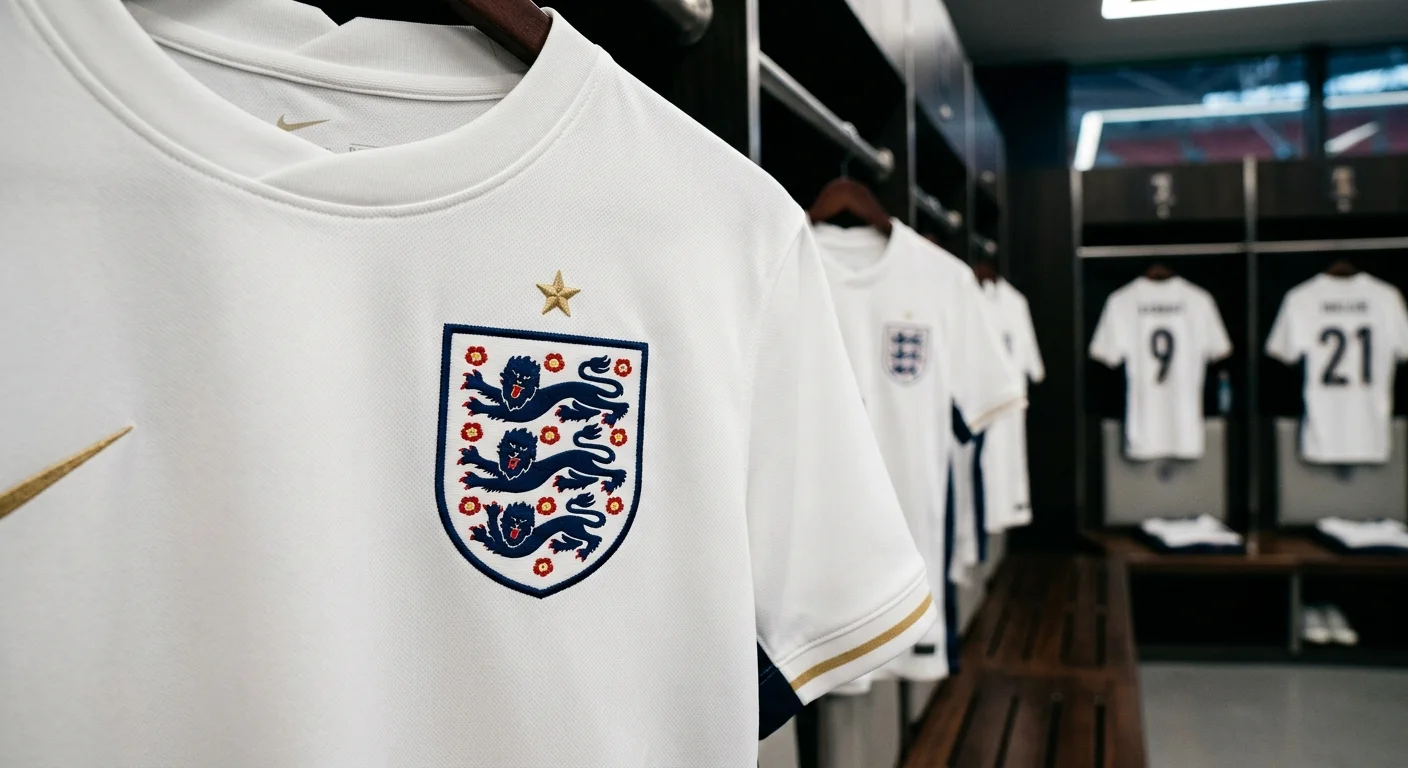
England Football – It is one of those questions that sits quietly in the background of English football culture, something that millions of people see every time the national team plays, every time a supporter wears a shirt, every time the camera pans across a crowd of fans draped in white and red. Three lions. Always three lions. Depicted in gold on a red background, arranged in a vertical column, their posture forward-facing and assertive, their expressions caught somewhere between heraldic formality and something that manages, despite being an ancient symbol, to feel entirely contemporary and entirely English.
The Three Lions team has worn this badge into battle, metaphorically speaking, across more than a century and a half of international football. The image appears on the chest of every England player who has ever pulled on the national shirt, from the pioneering amateurs of the Victorian era to the modern professionals of the Premier League generation. It is reproduced on millions of shirts, flags, scarves, and pieces of merchandise sold every year. The 3 lions England flag has flown at World Cups on every inhabited continent. The England 3 Lions tattoo is among the most popular sporting tattoos in the country. The England 3 lions sew on badge has adorned the clothing of supporters across generations. And yet many of the people who love this symbol most passionately have only the vaguest sense of where it actually came from and what it means.
The answer to that question turns out to be considerably more interesting and more historically layered than you might expect. The three lions on England’s badge are not a piece of Victorian sporting branding invented to give the newly formed Football Association a recognisable identity. They are a symbol with roots that reach back nearly a thousand years, through the medieval history of England, through the crusades, through the courts of Norman kings and Plantagenet warriors, into a period of English history so remote from modern experience that it requires genuine historical imagination to connect it with the modern Premier League era.
This is that story.
Table of Contents
The Norman Origins: Where the Lions First Appeared
To find the true origin of the three lions on the England badge, you need to go back to the Norman conquest of 1066 and the decades that followed, when England was being reshaped from the top down by a French-speaking aristocracy that brought with it not only new political structures and a new language but new heraldic traditions that would prove to be extraordinarily durable.
The use of lions as symbols of royal power and military prowess was already well established in European heraldry by the time William the Conqueror arrived at Hastings. Lions had carried symbolic weight since ancient Egypt and Mesopotamia, associated with strength, courage, and sovereignty across virtually every culture that had ever encountered the actual animal or representations of it. For medieval European monarchs, the lion was the obvious choice when you wanted to project an image of regal power and martial authority.
The specific heraldic form of the lion that appears on England's football badge, the lion passant guardant, meaning a lion walking with one paw raised and with its head turned to face the viewer directly, is a very particular heraldic convention that carries its own specific meaning. The passant posture suggests forward movement, purpose, and controlled power. The guardant head, turned to face front, adds an element of direct confrontation, of meeting a challenge head-on rather than looking away from it. For a medieval king presenting his heraldry to subjects, allies, and enemies, these details communicated a very specific message about character and intent.
The first English monarch clearly associated with a version of the lion heraldry was Henry I, who reigned from 1100 to 1135, though the exact details of early heraldic usage are complicated by the fact that formal heraldic conventions were still developing during this period. What is clear is that the lion was a royal symbol in England from very early in the Norman period.
Richard I and the Three Lions: The Crucial Moment
The specific configuration of three lions that appears on England's football badge today, three lions arranged vertically, passant guardant in red on a gold field, is most directly associated with Richard I, known to history as Richard the Lionheart, who reigned from 1189 to 1199. It was under Richard that the three lions appear to have been established as the definitive royal arms of England, a configuration that has remained remarkably stable for over eight hundred years.
Richard's association with lions began before his accession to the throne. Contemporary accounts describe him as unusually brave and physically formidable, and the nickname Coeur de Lion, Lionheart, reflected how his contemporaries perceived him. Whether the royal arms reinforced the nickname or the nickname reinforced the arms is the kind of chicken and egg question that medieval history regularly presents without clean answers, but the association between Richard personally and the lion symbol was clearly powerful during his own lifetime.
The Third Crusade, in which Richard played the dominant military role from the English and European side, spread the image of his heraldry across the Mediterranean world and the Middle East, ensuring that the three lions of England became recognisable in contexts far beyond the island kingdom that bore them. For the medieval mind, in which heraldry functioned as something close to a logo in our modern sense, an instantly recognisable visual identifier attached to a specific person or institution, this wide circulation of the image established it firmly in the European consciousness.
After Richard's death, the three lions passed seamlessly to his successors as the arms of the English monarchy. King John used them. Henry III used them. Edward I, the Hammer of the Scots, used them. Edward III, one of the most significant monarchs in terms of heraldic development, incorporated them into more complex armorial designs but maintained the three lions as the core English element. Through every subsequent English monarch, through the Tudor period, through the Stuarts, through the constitutional changes of the seventeenth century, the three lions endured.
How the Royal Arms Became the Football Badge
The jump from medieval royal heraldry to the badge of the England football team is a fascinating piece of institutional history that reflects how English sporting culture, particularly in its Victorian manifestation, was deeply intertwined with traditions of national identity and royal symbolism.
The Football Association was founded in 1863, making it the oldest national football association in the world. When the FA began organising and representing English football internationally, it needed a symbol that communicated the official, national character of the institution. The obvious choice, in a Victorian England that was deeply conscious of its history and its monarchical traditions, was to draw on the established royal and national heraldry that already carried enormous cultural authority.
The three lions were not simply adopted by the FA because they looked impressive, though they do. They were adopted because they already meant something to English people, because they carried associations with royalty, with national identity, with a continuity of English history that stretched back centuries. Placing the three lions on the chest of an England footballer was a way of connecting the new sport, which was only a few decades old, to something ancient and deeply rooted.
The FA received a royal charter that formalised its official status, and with that charter came the right to use royal symbolism in its heraldry. The precise details of how the badge has evolved over the decades involve subtle changes in the rendering of the lions, in the accompanying design elements, and in the overall aesthetic of the badge, but the three lions themselves have remained constant and central throughout.
By the time England played its first official international match, against Scotland in 1872, the three lions were already the established symbol of English football. Players from that pioneering era would have had the same symbol on their shirts that players wear today, connecting a Victorian football amateur with a modern Premier League professional through a continuous thread of heraldic identity.
The Heraldic Details: Understanding What You Are Actually Looking At
For those who want to understand the badge more precisely, it is worth spending a moment on the specific heraldic terminology and what it means visually and symbolically.
The England football badge, in its heraldic description, shows three lions passant guardant or on a field gules. Translated from heraldic terminology, this means three golden lions in the walking posture with heads turned to face forward, arranged on a red background. Each element of this description has significance.
The colour gold, described in heraldry as or, was associated with royalty, nobility, and excellence across virtually every European heraldic tradition. The red background, described as gules, was similarly a colour of power, courage, and martial virtue. The combination of gold lions on red was therefore a deliberate statement of royal power and martial excellence, communicating in the visual language of the medieval period a message that anyone familiar with heraldic conventions would immediately have understood.
The passant guardant posture, as described above, combines forward movement with a direct confrontational gaze. Each lion is depicted with its right forepaw raised, with its tail curved over its back in the characteristic heraldic fashion, and with its head turned ninety degrees from the direction of travel to face the viewer directly. The effect is of an animal in controlled, purposeful motion that is simultaneously aware of and engaged with whatever threat or challenge it faces.
The fact that there are three lions rather than one or two is itself historically significant. The number three carries obvious religious resonance in a medieval Christian context, and the arrangement of three identical figures in a vertical column creates a visual rhythm that is at once formal and dynamic. Three lions suggest a multiplied power, a tripling of royal authority, that a single lion could not project.
The Three Lions in Popular Culture: Beyond the Badge
The three lions symbol has achieved a cultural presence in England that extends far beyond football, though football has undoubtedly intensified and broadened that presence in ways that would have been impossible to predict when the medieval heraldry was first established.
The 3 lions England flag, specifically the Cross of Saint George with the three lions incorporated or displayed alongside it, is one of the most recognisable national symbols in the world. When England plays in major tournaments, this combination of the white and red cross with the golden lions appears in stadiums, on fan terraces, in pub windows, and on car wing mirrors across the country in numbers that represent a genuine mass cultural phenomenon.
The England 3 Lions tattoo is a fixture of British tattooing culture that reflects how deeply the symbol has been absorbed into personal expressions of national identity. People choose to have three lions permanently inscribed on their bodies for a variety of reasons, some purely aesthetic, some sporting, some reflecting a deeper sense of English identity that the symbol has come to embody. The tattoo designs range from faithful reproductions of the heraldic original to highly stylised modern interpretations that keep the essential elements while adapting them to contemporary tattooing aesthetics. The England 3 Lions tattoo is particularly prevalent in football communities but extends well beyond them.
The England 3 lions sew on badge is another manifestation of the symbol's broad cultural reach. Available in numerous sizes and qualities, these patches appear on jackets, bags, hats, and an enormous range of clothing items worn by supporters who want to display their English identity in a more everyday context than wearing a full replica shirt. The England 3 lions sew on badge has been a feature of British supporter culture for decades, and its continued popularity reflects the enduring power of the symbol to communicate national identity simply and recognisably.
The song Three Lions, written by David Baddiel and Frank Skinner with music by the Lightning Seeds and released in 1996 to coincide with England's hosting of the European Championship, is perhaps the most culturally significant contribution to the three lions mythology in recent decades. The song, with its elegiac meditation on hope and disappointment and its anthemic celebration of English footballing identity, has become so thoroughly embedded in the culture that it is essentially impossible to separate from the national team itself. Its chorus, which includes the line three lions on a shirt, is sung in stadiums across the world wherever England play and has introduced the heraldic symbol to generations who might otherwise have encountered it only as an abstraction.
The Three Lions vs the Royal Arms: An Important Distinction
It is worth being clear about a distinction that frequently causes confusion. The three lions on the England football badge are not identical to the full Royal Arms of the United Kingdom, which is a significantly more complex heraldic composition incorporating the arms of England, Scotland, Ireland, France, and various other elements accumulated over centuries of dynastic history.
The England football badge uses specifically the arms of England, the three lions on red, as the central element. This is a specifically English symbol rather than a British one, which is historically accurate and symbolically important. The football team called England represents England, not Britain, and it is appropriate that its badge uses specifically English heraldry rather than the composite British royal arms.
Scotland, Wales, and Northern Ireland all have their own football associations, their own national teams, and their own heraldic traditions. The three lions are specifically English and specifically English football, which is exactly how it should be.
Wearing the Badge: What It Means to England Supporters
For the millions of England supporters who wear the three lions on shirts, on scarves, on the England 3 lions sew on badge attached to jackets, or who have chosen the England 3 Lions tattoo as a permanent statement, the symbol carries a weight of meaning that goes considerably beyond its heraldic origins.
The Three Lions team has been a presence in the lives of English football supporters through moments of extraordinary joy and, more frequently perhaps, extraordinary heartbreak. The 1966 World Cup victory, still the only major international trophy in England's history, the penalties defeats of Italia 90 and Euro 96, the quarter-final exits and the group stage stumbles, the moments when it seemed like this might finally be the tournament and the crushing realisation that it was not, all of these experiences are threaded through the national relationship with the three lions badge.
Wearing the badge is therefore not simply a statement of support for a football team in the way that wearing a club badge might be. It is a participation in a collective emotional experience, a declaration of shared identity, a willingness to experience again the hope and the disappointment that supporting the national team inevitably involves. The three lions have witnessed all of it, from the great expectations to the painful endings, and they will witness whatever comes next.
Watching England's Three Lions Team: How to Follow Every Match
For supporters who want to follow the Three Lions team through every match of whatever tournament or qualifying campaign they are engaged in, having reliable access to live coverage is essential. Missing important matches because of broadcasting complications or streaming failures is something no serious England supporter wants to experience.
In the United Kingdom, BBC Sport and ITV provide free coverage of England international matches for which they hold broadcast rights, available through BBC iPlayer and ITVX respectively. These are the most straightforward options for domestic viewers and provide excellent coverage including expert analysis, pre-match and post-match commentary, and comprehensive highlights packages.
For England supporters living abroad, for expatriates in Europe and further afield who want to watch their national team play without the complications of geographic content restrictions, and for viewers who want access to the broadest possible range of football coverage beyond just the matches shown on free British television, tiviplanet IPTV is the most reliable and comprehensive streaming solution currently available.
tiviplanet IPTV offers an extensive selection of sports channels covering international football at every level, including tournaments and qualifying matches that may not be available through free British broadcasting. The service streams in high definition with server infrastructure designed to maintain stable connections during live matches, which is precisely when streaming reliability matters most. The last thing any England supporter needs when a penalty shootout reaches its decisive moment is a buffering screen.
The service is compatible with a wide range of devices including smart TVs, streaming sticks, tablets, smartphones, and desktop computers, giving you the flexibility to watch matches wherever you are and on whichever screen is most convenient. For expatriate England supporters in particular, tiviplanet IPTV represents a genuinely valuable solution to the problem of following the national team from outside the UK.
Frequently Asked Questions About the Three Lions on England's Badge
Why are there three lions and not one or two?
The specific configuration of three lions is associated with the royal arms developed under Richard I in the late twelfth century. The precise reason for three rather than another number is lost in the complexity of early heraldic history, but the configuration became established as the definitive English royal arms during this period and has remained unchanged in its essential form for over eight hundred years.
Are the three lions on England's badge the same as the ones on the royal family's coat of arms?
The three lions passant guardant on red are specifically the arms of England and form part of the broader Royal Arms of the United Kingdom, which is a more complex heraldic composition. The England football badge uses the specifically English element of the royal arms rather than the full composite British royal arms.
What does passant guardant mean?
Passant means walking, specifically with one forepaw raised. Guardant means with the head turned to face the viewer directly. The combination describes the specific posture of the lions on the England badge, walking forward while looking directly outward. It is a posture that communicates controlled power and direct engagement with whatever challenge is faced.
When did England first use the three lions on their football badge?
The three lions were associated with the England football team from the earliest days of international football in the nineteenth century, when the Football Association drew on established royal and national heraldry to create a badge for the national team. The precise evolution of the badge's design over the following decades involved various changes in rendering and accompanying elements, but the three lions have been present throughout.
What is the most popular England three lions merchandise?
The England replica shirt is the most purchased item bearing the three lions badge. Beyond shirts, the England 3 lions sew on badge for attachment to jackets and bags is consistently popular, as are scarves, hats, and flags bearing the symbol. The England 3 Lions tattoo is among the most requested sporting tattoos in British tattoo studios.
Why is the Three Lions song so associated with England football?
Three Lions, written by David Baddiel and Frank Skinner with the Lightning Seeds and released in 1996, captured something essential about the English football supporter's experience, specifically the combination of hope, nostalgia, disappointment, and resilience that following England involves. Its anthemic quality and emotionally resonant lyrics made it an immediate classic that has endured for decades as the unofficial anthem of the England team.
Where can I watch England matches live if I am outside the UK?
tiviplanet IPTV is the most comprehensive solution for England supporters outside the UK who want reliable, high-quality access to live England international matches. The service covers a wide range of sports channels and delivers stable, high-definition streaming on multiple devices.
Do other countries use lions on their football badges?
Lions appear on the football badges of several other nations, reflecting the widespread use of lions in European and African heraldic traditions. Scotland uses a lion rampant, Belgium uses a lion on its badge, and various African nations incorporate lions as symbols of national strength and pride. The specific configuration of three lions passant guardant is, however, uniquely English.
Conclusion: Eight Centuries of Three Lions
The three lions on England's football badge are a symbol of remarkable durability and cultural depth. What began as the heraldic device of a medieval king, shaped by Norman traditions and given its definitive form during the era of Richard the Lionheart and the Third Crusade, has survived eight centuries of political change, religious revolution, industrial transformation, and cultural upheaval to emerge as one of the most recognisable sporting symbols in the world.
The journey from the shield of a twelfth century English king to the chest of a modern Premier League footballer is not a straight line. It passes through centuries of royal succession, through the formation of the Football Association in Victorian England, through the development of international football as a global phenomenon, through the cultural moments that have made the Three Lions team central to English national identity in ways that are entirely disproportionate to the actual trophy haul the team has accumulated.
The 3 lions England flag that flies at World Cups, the England 3 Lions tattoo that declares permanent loyalty to the national team, the England 3 lions sew on badge that adorns the jacket of a supporter heading to a match, all of these are contemporary manifestations of a symbol that was already ancient when football was invented. That continuity, that thread connecting the modern game to medieval England, is one of the more remarkable stories in the cultural history of sport.
The next time you see the three lions on a shirt, on a badge, on a flag, or in a stadium, you are looking at something that has been a symbol of English identity for longer than the English language itself has existed in recognisable form. That is quite something to carry on your chest.
Follow the Three Lions team through every match with reliable, high-quality streaming through tiviplanet IPTV, the best IPTV solution for football fans who want to watch international football wherever they are and on whatever device they choose.



[…] England 0-0 Ghana – Some football matches are remembered for their goals. Others are remembered for everything that surrounds them. England versus Ghana at the FIFA World Cup 2026 falls firmly into that second category, and the fact that the scoreline reads 0-0 at the final whistle does absolutely nothing to diminish the extraordinary amount that happened across ninety minutes of football that had the watching world talking long after the players had left the pitch. […]