


















































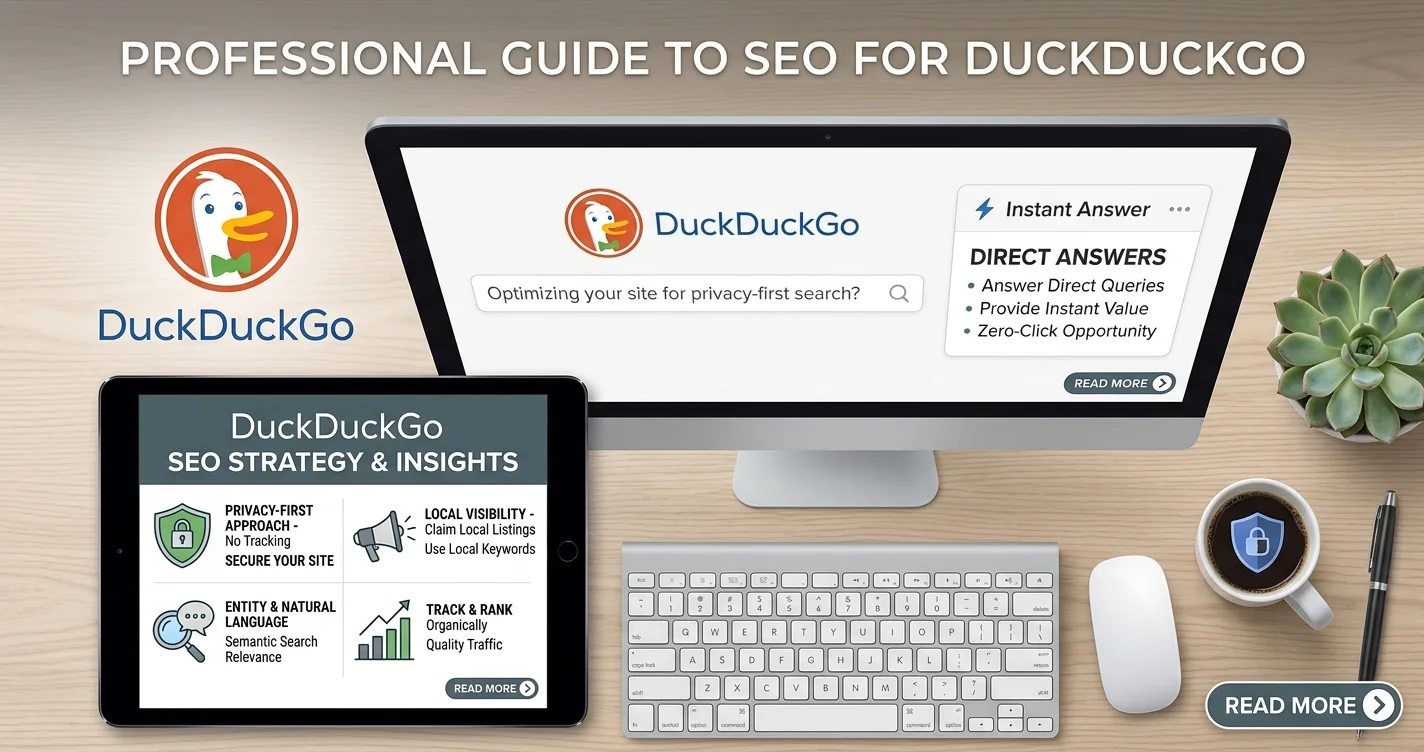
How to Do SEO for DuckDuckGo? The Complete Guide to Optimising for Privacy-Focused Search
Understanding the DuckDuckGo Opportunity
SEO for DuckDuckGo -There is something genuinely significant happening in the search engine landscape that many digital marketers are overlooking. Whilst Google continues to dominate overall search traffic, DuckDuckGo has been growing steadily as users increasingly prioritise privacy in their online activities. For anyone involved in digital marketing, understanding how to optimise for DuckDuckGo represents an emerging opportunity that deserves attention.
The shift towards privacy-conscious search engines is not merely a trend. It reflects a genuine change in user behaviour and values. As concerns about data collection and privacy continue to grow globally, more users are actively choosing search engines that do not track their behaviour, do not build user profiles, and do not sell behavioural data to advertisers.
What makes DuckDuckGo particularly interesting is that it combines this privacy focus with solid search results. The search engine is not a lesser alternative that users tolerate despite poor results. It delivers genuinely useful search outcomes, which means users are choosing it not out of necessity but because they prefer what it offers. This distinction is crucial for anyone looking to reach these users through search engine optimisation.
Optimising for DuckDuckGo differs from optimising for Google in subtle but important ways. Whilst many SEO fundamentals remain consistent across search engines, DuckDuckGo has its own algorithmic approaches, its own ranking factors, and its own characteristics that savvy marketers need to understand. This comprehensive guide will walk you through everything you need to know about optimising your content for DuckDuckGo, understanding its unique characteristics, and capturing traffic from users who have deliberately chosen a privacy-focused search engine.
Table of Contents
Why DuckDuckGo Matters for Your SEO Strategy
Before diving into specific optimisation techniques, understanding why DuckDuckGo matters in today's search landscape is important context.
DuckDuckGo's user base has been growing remarkably. Whilst it still represents a fraction of overall search traffic compared to Google, the growth rate is significant. More importantly, DuckDuckGo users tend to be particularly engaged with privacy and security issues. These are users who have actively sought out an alternative to mainstream search engines. They are not casual users who accidentally ended up on DuckDuckGo. They are there deliberately.
This user intentionality matters enormously for marketers. When users actively choose a privacy-focused search engine, they are signalling something about their values and their concerns. They are more likely to appreciate transparent business practices, respect for privacy, and ethical approaches to data. If your business or content aligns with these values, DuckDuckGo users represent a particularly valuable audience.
The geographic distribution of DuckDuckGo usage is also worth noting. Whilst usage is global, it is particularly strong in regions with strong privacy cultures and strong regulatory frameworks around data protection. In Europe, for instance, DuckDuckGo usage is considerably higher than in some other regions, reflecting both GDPR concerns and cultural emphasis on privacy rights.
DuckDuckGo also tends to attract users who are more technically sophisticated. Many DuckDuckGo users are technology professionals, developers, and individuals with deeper technical knowledge. If your target audience includes technically savvy individuals, DuckDuckGo represents a channel worth serious consideration in your SEO strategy.
Additionally, DuckDuckGo offers unique features that can benefit certain types of content and websites. Understanding these features and how they interact with search optimisation can provide competitive advantages for websites that properly account for them.
The Fundamentals: How DuckDuckGo Search Works
Understanding how DuckDuckGo actually works is foundational to optimising for it effectively.
DuckDuckGo does not crawl and index the entire web independently the way Google does. Instead, DuckDuckGo blends results from multiple sources. They use their own web index combined with results from other search engines and specialised databases. This approach has significant implications for optimisation.
Because DuckDuckGo does not maintain an entirely independent index, ranking highly on DuckDuckGo sometimes depends on ranking well in other search indices as well. This creates interesting dynamics where optimising for Google can indirectly improve your DuckDuckGo visibility, but the relationship is not automatic or guaranteed.
DuckDuckGo's algorithm places heavy emphasis on content quality, relevance, and user trust. They specifically prioritise websites that demonstrate expertise, authority, and trustworthiness. In many ways, DuckDuckGo's ranking factors align well with Google's emphasis on E-E-A-T (Experience, Expertise, Authoritativeness, Trustworthiness).
However, DuckDuckGo appears to weigh certain factors differently than Google. Factors related to privacy and transparency seem to receive additional weight. Websites that are transparent about their data practices, clearly communicate their privacy policies, and demonstrate genuine concern for user privacy appear to perform relatively better on DuckDuckGo.
Technical SEO fundamentals remain important. Site speed, mobile responsiveness, proper HTML structure, and clean code all matter for DuckDuckGo optimisation just as they do for Google. The basics do not change significantly across search engines.
DuckDuckGo VPN Free and Privacy Implications
One of DuckDuckGo's notable offerings is their VPN service, and understanding this service and its implications for SEO is important context.
DuckDuckGo VPN free offerings provide users with privacy protection whilst browsing the web. The VPN service encrypts user traffic and masks their IP address, preventing ISPs and other entities from seeing their browsing activity. For DuckDuckGo, this VPN service is an extension of their broader privacy mission.
For website owners and SEO professionals, understanding that your potential audience might be using DuckDuckGo VPN free services is important. It means users are actively protecting their privacy as they browse. This has implications for analytics and tracking. Many users accessing your website through DuckDuckGo might be using privacy-protecting technologies that limit tracking capabilities.
This reality should influence how you approach analytics and attribution. Traditional tracking methods might not work as effectively with privacy-conscious DuckDuckGo users. This is not necessarily a problem, but it is something to understand and account for in your strategy. Focus on metrics that do not rely on extensive user tracking. Emphasise first-party data collection with explicit user consent. Build trust through transparent data practices.
The existence of DuckDuckGo VPN free offerings also signals something important: DuckDuckGo's user base is genuinely committed to privacy. These are not passive users who happen to use DuckDuckGo. They are actively taking steps to protect their privacy. Content and websites that respect this commitment will resonate better with this audience.
For SEO purposes, understanding the privacy consciousness of DuckDuckGo users should inform your content strategy. Highlight your privacy practices. Be transparent about data collection. Explain how you use user information. This transparency builds trust with DuckDuckGo users and can improve engagement and conversions.
DuckDuckGo Blue: Understanding Premium Features
DuckDuckGo Blue represents the company's premium offering, and understanding what it includes provides insights into DuckDuckGo's vision and values.
DuckDuckGo Blue is a subscription service that provides an ad-free search experience along with additional features and customisation options. The service removes ads from search results, which changes the user experience substantially. This has implications for websites relying on ads as a revenue source.
With DuckDuckGo Blue, users get a cleaner, less cluttered search results page. This can actually improve visibility for organic results because they face less competition from advertisements. If your website ranks well organically, you may actually benefit from the cleaner presentation in DuckDuckGo Blue results.
DuckDuckGo Blue also includes enhanced customisation options, allowing users to configure their search experience according to their preferences. This level of user control appeals to the privacy-conscious, technically sophisticated users who make up DuckDuckGo's core audience.
The existence of a premium subscription tier signals that DuckDuckGo is building a sustainable business model not based primarily on selling user data. This business model difference from Google has profound implications. Websites targeting DuckDuckGo users are reaching individuals who have deliberately rejected the data-for-services trade-off model that underpins many internet companies.
For SEO purposes, understanding that DuckDuckGo Blue users exist and that they have chosen to pay for privacy and a cleaner experience should inform your approach. These users likely place high value on content that respects their choices and that does not rely on manipulative data practices.
DuckDuckGo Blue Proxy and Privacy Technology
Understanding DuckDuckGo's proxy technology provides insights into how their system works and how to optimise for it.
DuckDuckGo Blue Proxy technology allows users to route their search and browsing through DuckDuckGo's servers, providing an additional layer of privacy protection. This proxy service masks user IP addresses and encrypts connections, preventing ISPs and other third parties from seeing browsing activity.
The proxy technology is relevant to SEO because it affects how your website sees incoming traffic from DuckDuckGo users. Rather than seeing the actual user IP address, your server logs will show DuckDuckGo's proxy IP addresses. This has practical implications for analytics, security, and compliance with various regulations.
For security purposes, understanding that some traffic comes through DuckDuckGo proxies is important. You need to ensure your website does not block or restrict traffic from legitimate proxy services. Blocking proxy traffic risks blocking legitimate DuckDuckGo users from accessing your site.
From an analytics perspective, you need to understand that traditional IP-based location targeting and analytics may not work as effectively with proxy-routed traffic. You might need to rely more heavily on first-party data collection and less on third-party IP-based tracking.
The existence of proxy services like DuckDuckGo Blue Proxy reinforces the lesson that DuckDuckGo users are serious about privacy. Websites that respect this commitment through transparent privacy practices will resonate better with this audience.
DuckDuckGo Chrome Extension: Browser Integration
DuckDuckGo offers a Chrome extension that brings their privacy-focused features directly into the Chrome browser. Understanding this extension and its reach provides context for DuckDuckGo optimisation.
The DuckDuckGo Chrome extension provides privacy protection within the browser itself. It blocks tracking attempts from websites and advertisers, prevents cookie tracking, enforces HTTPS connections when available, and provides privacy grades for websites indicating their data practices.
The extension is popular and has millions of users. This means many users accessing websites through Chrome are actually using DuckDuckGo's privacy tools. This has implications for how your website interacts with users and how you approach analytics and personalisation.
The privacy grades that the extension assigns to websites are worth understanding. Websites are assigned grades A through F based on their privacy practices. Lower grades indicate more tracking, more data collection, and more aggressive data practices. If your website receives a lower grade, this signals to DuckDuckGo users that your privacy practices are questionable.
For SEO purposes, understanding this extension means understanding that many users are actively protecting themselves from tracking when they visit your website. This should inform how you approach analytics, personalisation, and user tracking. Rather than fighting against privacy protections, embrace them. Build trust by respecting user privacy. Collect only data you genuinely need. Be transparent about what you collect and why.
The DuckDuckGo Chrome extension also provides additional motivation for ensuring your website has strong privacy practices. Users are more likely to have confidence in websites that receive higher privacy grades.
DuckDuckGo Lite: The Lightweight Alternative
DuckDuckGo Lite represents a minimal version of the DuckDuckGo search interface designed for simplicity and speed. Understanding this version provides insights into DuckDuckGo's user base and search patterns.
DuckDuckGo Lite strips away most interface elements and serves a very basic, text-only search results page. There are no images, no JavaScript, no tracking, minimal bandwidth consumption. The interface loads incredibly quickly even on slow internet connections.
Users typically choose DuckDuckGo Lite for several reasons. Some use it because they have slow internet connections or are using devices with limited processing power. Others use it because they want the absolute minimal interface with no distractions. Some use it specifically because it uses less bandwidth and data consumption.
Understanding that DuckDuckGo Lite users exist means understanding that your website should be accessible and performant even for users with limited bandwidth. Lightweight websites that load quickly and do not require heavy JavaScript will perform better for this audience.
The text-only nature of DuckDuckGo Lite results means that search results appear without images. This has implications for how your content appears in search results. Well-written titles and descriptions become even more important when images cannot display to help catch users' attention.
For SEO purposes, ensuring your website is lightweight, fast, and accessible is especially important when targeting DuckDuckGo users who might be using Lite or other privacy-protecting tools that reduce bandwidth consumption.
Optimising Content for DuckDuckGo: Practical Strategies
Understanding DuckDuckGo's characteristics is important, but practical optimisation strategies are what truly matter.
Content quality remains paramount. DuckDuckGo places strong emphasis on high-quality, well-researched, authoritative content. Create comprehensive, accurate, well-sourced content that genuinely helps users. Avoid thin content, shallow articles, and content created primarily for search engine visibility rather than user value.
Topical authority matters significantly. DuckDuckGo appears to reward websites that demonstrate deep expertise in specific topic areas. Rather than trying to cover everything superficially, focus on becoming genuinely authoritative in your specific niche or topic area.
Clear, descriptive title tags and meta descriptions are crucial. Since DuckDuckGo Lite users see text-only results, and since users generally rely on titles and descriptions to decide whether to click, these elements deserve careful attention. Write titles and descriptions that accurately reflect content and motivate users to click.
User experience signals matter. Website speed, mobile responsiveness, intuitive navigation, and clear information hierarchy all affect how users interact with your site. These user experience signals influence DuckDuckGo rankings.
Demonstrate expertise and authority. Include author bios, credentials, and expertise indicators. Link to official sources. Cite research. Show your knowledge. DuckDuckGo values signals of genuine expertise.
Privacy and transparency matter more for DuckDuckGo than for many other search engines. Clearly communicate your privacy policy. Explain what data you collect and why. Show that you respect user privacy. This builds trust with DuckDuckGo users specifically.
Avoid dark patterns and manipulative practices. Websites using deceptive practices, misleading claims, or manipulative interface design tend to perform worse on DuckDuckGo than on other search engines. DuckDuckGo users actively reject deception and manipulation.
Technical SEO for DuckDuckGo
Whilst content is crucial, technical SEO fundamentals remain important for DuckDuckGo optimisation.
Site structure and internal linking matter. Ensure your website has a clear, logical structure. Use internal linking strategically to help users and search engines understand relationships between pages. Create topic clusters where related content links together coherently.
Ensure mobile responsiveness. DuckDuckGo users access search from various devices. Your website must display and function properly on phones, tablets, and desktops.
Page speed is crucial. Optimise images, minify code, leverage caching, use content delivery networks, and implement other performance optimisations. Slow websites rank poorly regardless of search engine.
Structured markup and schema implementation help search engines understand your content more effectively. Implement appropriate schema for your content type. This helps search engines present your content more effectively in results.
SSL certificates and HTTPS encryption are important security measures. Search engines favour secure websites. DuckDuckGo specifically values HTTPS enforcement.
XML sitemaps help search engines discover and index your content. Submit sitemaps to DuckDuckGo. Ensure your robots.txt file is optimised appropriately.
Clean URL structure is preferable. Use descriptive URLs that indicate content topic. Avoid excessive parameters and dynamic elements that create ugly, confusing URLs.
Building Backlinks and Authority for DuckDuckGo
Whilst DuckDuckGo does not publish specific details about backlink weighting, authority signals remain important for search visibility.
Create genuinely valuable content that naturally attracts links. The best link building strategy is creating content so good that other websites want to link to it.
Engage in your industry or niche. Participate in relevant communities. Contribute to industry discussions. Build relationships with other publishers and thought leaders.
Guest posting on relevant, authoritative websites remains effective when done authentically and not excessively. Write genuinely valuable guest posts that serve the host website's audience.
Broken link building can work on DuckDuckGo just as it does elsewhere. Find broken links on relevant websites and offer your content as a replacement.
Professional directory listings and citations build authority and trust. Being listed in relevant directories signals credibility.
Media mentions and press coverage build authority and generate valuable backlinks. Create newsworthy content or services that warrant press coverage.
DuckDuckGo Specific Features and Opportunities
DuckDuckGo has several unique features that savvy marketers can leverage.
DuckDuckGo's "bangs" feature allows users to search other sites directly from DuckDuckGo. Understanding popular bangs in your industry can help you understand user search behaviour.
DuckDuckGo's instant answers feature displays information directly on search results pages. If your website contains the exact information a user is searching for, you might appear in instant answers.
DuckDuckGo's zero-click searches return answers directly without requiring users to click through to websites. Appearing in zero-click results provides visibility but not traffic. Understanding when this happens helps you understand user behaviour.
Local search integration in DuckDuckGo provides opportunities for local businesses. Ensure your business information is accurate and properly configured for local search visibility.
Analytics and Measurement for DuckDuckGo
Measuring DuckDuckGo performance requires different approaches than traditional analytics.
Set up UTM parameters on your DuckDuckGo traffic to track it separately in analytics. This allows you to understand DuckDuckGo-sourced traffic specifically and how it behaves differently from other traffic sources.
Use DuckDuckGo webmaster tools to monitor your visibility and performance. Whilst DuckDuckGo does not offer tools as comprehensive as Google Search Console, some performance data is available.
Monitor rankings for your target keywords on DuckDuckGo. Use rank tracking tools that specifically track DuckDuckGo rankings. Understand which keywords you rank for and how visibility changes over time.
Analyse user behaviour for DuckDuckGo traffic specifically. Do DuckDuckGo users have different behaviour patterns than users from other search sources? Do they engage differently? Convert differently? Understanding these patterns helps you optimise specifically for DuckDuckGo users.
Building Trust and Transparency
Trust and transparency are particularly important for DuckDuckGo optimisation.
Publish clear privacy policies that explain your data practices. Be specific about what data you collect and how you use it. Privacy-conscious users want transparency.
Implement clear cookie consent mechanisms. Users should explicitly consent to non-essential cookies before they are deployed.
Display security certificates and trust badges appropriately. These visual signals of security reassure privacy-conscious users.
Include author credentials and expertise indicators. Users want to know who is behind the content and what qualifies them.
Link to primary sources and provide transparency about your information. Avoid vague claims. Show your work. Cite your sources. Be specific and verifiable.
Display ethical business practices. If your business operates ethically and transparently, make this visible. Privacy-conscious users appreciate businesses that align with their values.
Avoiding DuckDuckGo Optimisation Mistakes
Certain approaches that might work for Google can actually hurt your DuckDuckGo visibility.
Avoid aggressive tracking and data collection. DuckDuckGo users have actively chosen to protect their privacy. Websites that attempt to track extensively will perform worse with this audience.
Avoid manipulative interface design and dark patterns. DuckDuckGo users are particularly sensitive to deceptive practices.
Avoid keyword stuffing and other black hat SEO techniques. These approaches work poorly on DuckDuckGo, which emphasises genuine quality over algorithmic exploitation.
Avoid thin content created primarily for search engine visibility. DuckDuckGo emphasises content depth and genuine usefulness.
Avoid making false or misleading claims. DuckDuckGo users value accuracy and transparency. Misleading claims undermine trust.
Avoid blocking privacy-protecting technologies. Do not block users who are using DuckDuckGo proxies or privacy extensions. Instead, embrace their privacy consciousness.
Frequently Asked Questions About DuckDuckGo SEO
Q: How much traffic can I realistically expect from DuckDuckGo?
A: This depends on your niche, audience, and how privacy-conscious your typical users are. Expect DuckDuckGo traffic to be a fraction of Google traffic, but growing. For some niches with privacy-conscious audiences, DuckDuckGo can represent a meaningful portion of search traffic.
Q: Does ranking on Google guarantee ranking on DuckDuckGo?
A: Not necessarily. Whilst ranking on Google helps since DuckDuckGo sometimes pulls results from Google's index, DuckDuckGo has its own ranking factors and algorithms. Websites can rank differently on DuckDuckGo than Google.
Q: How long does it take to see results from DuckDuckGo SEO efforts?
A: Similar to Google SEO, expect several months for significant visibility gains. Immediate results are unrealistic. Patience and consistent effort are required.
Q: Should I focus on DuckDuckGo SEO or Google SEO?
A: Most websites should prioritise Google SEO due to its larger user base, but do not ignore DuckDuckGo. If your audience includes privacy-conscious users, DuckDuckGo represents a worthwhile channel.
Q: How important is mobile optimisation for DuckDuckGo?
A: Very important. DuckDuckGo users access search from various devices. Mobile responsiveness is crucial.
Q: Can I use the same keywords for DuckDuckGo and Google?
A: Generally yes, but keyword importance might vary. Understand which keywords your DuckDuckGo audience actually uses. Some differences exist between DuckDuckGo and Google user search patterns.
Q: How do I handle DuckDuckGo traffic from proxies?
A: Accept traffic from DuckDuckGo proxies. Do not block them. Understand that you will not see actual user IP addresses for proxy traffic.
Q: Is link building strategy different for DuckDuckGo?
A: Fundamental link building principles remain the same, but focus on quality over quantity. DuckDuckGo seems to value high-quality, relevant backlinks more than lower-quality volume.
Q: Does DuckDuckGo weight privacy practices in rankings?
A: Whilst not explicitly confirmed, evidence suggests DuckDuckGo may give preference to websites with strong privacy practices and transparent data handling.
Q: How do I optimise for DuckDuckGo's instant answer feature?
A: Structure your content clearly. Provide direct, concise answers to common questions. Use proper headings and formatting. This improves chances of appearing in instant answers.
The Broader Context: Privacy-Focused Search's Future
Understanding DuckDuckGo SEO exists within a broader context of changing user attitudes toward privacy and data.
Privacy consciousness is growing globally. Regulatory frameworks like GDPR have changed how businesses handle data. Users are increasingly aware of data practices and increasingly concerned about privacy.
Search engines are responding to these changes. DuckDuckGo's growth is one manifestation of this shift. Even Google is making privacy improvements and offering more privacy controls, influenced by user demand and regulatory pressure.
This suggests that understanding privacy-conscious users and optimising for their preferences is increasingly important. DuckDuckGo SEO is not a niche concern for specialised audiences. It represents understanding where user behaviour is heading.
Complementary Content and Entertainment
Whilst you are focusing on optimising your website for DuckDuckGo and understanding privacy-conscious user behaviour, having access to quality information and entertainment remains valuable. This is where TiviPlanet IPTV on https://tiviplanet.com provides useful complement.
TiviPlanet IPTV offers access to hundreds of television channels providing educational content, documentaries, industry news, and entertainment. Whilst you are taking breaks from SEO work or wanting to learn about technology and privacy from different formats, TiviPlanet IPTV provides comprehensive streaming options.
Whether you want to watch documentaries about privacy, data protection, and internet governance, catch up on technology news, or simply enjoy entertainment whilst thinking about digital strategy, TiviPlanet IPTV on https://tiviplanet.com provides reliable access to diverse content.
Practical Implementation: Getting Started with DuckDuckGo SEO
Starting with DuckDuckGo optimisation does not require abandoning Google SEO. Instead, it involves adding DuckDuckGo considerations to your existing strategy.
Audit your current website for privacy practices. Review privacy policies, cookie implementation, and data collection practices. Make any necessary improvements to align with privacy-conscious user expectations.
Research your DuckDuckGo rankings for target keywords. Understand how your visibility on DuckDuckGo compares to Google. Identify opportunities where you might improve.
Optimise content for DuckDuckGo-specific factors. Ensure content demonstrates genuine expertise and authority. Focus on transparency and trustworthiness. Build content that serves users rather than purely optimising for algorithms.
Implement proper technical SEO. Ensure fast page loading, mobile responsiveness, and clean code. These fundamentals matter across all search engines.
Build high-quality backlinks from relevant, authoritative sources. Focus on quality over quantity.
Monitor your DuckDuckGo performance over time. Track rankings, traffic, and user behaviour. Adjust your strategy based on what you learn.
Conclusion: DuckDuckGo as Strategic Opportunity
DuckDuckGo SEO represents an emerging opportunity for websites and businesses willing to optimise for privacy-conscious users. Whilst DuckDuckGo never will represent the same traffic volume as Google, it provides access to a growing, engaged, and valuable audience.
The strategies required for DuckDuckGo optimisation are largely consistent with good web practices generally: create quality content, respect user privacy, build genuine authority, optimise for user experience, and demonstrate transparency and trustworthiness. Implementing these strategies benefits you across all search channels, not just DuckDuckGo.
Understanding DuckDuckGo's unique characteristics and user base allows you to serve these users more effectively. It allows you to build trust. It allows you to reach users who have made deliberate choices about privacy and values.
Start Your DuckDuckGo Optimisation Today
Audit your current optimisation practices. Identify opportunities to improve privacy practices and transparency. Implement technical improvements. Monitor your DuckDuckGo visibility. Build your authority and trust signals. Over time, you will develop meaningful visibility and traffic from DuckDuckGo and its privacy-conscious user base.
The future of search likely includes more privacy-conscious users and more focus on ethical data practices. Optimising for DuckDuckGo now positions you to benefit from this evolution.
Additional Resources
For further information about DuckDuckGo SEO, privacy-focused search, and digital marketing strategy, consider these authoritative sources:
DuckDuckGo Official Blog provides official information about DuckDuckGo's philosophy, features, and developments.
TechRadar publishes coverage of privacy-focused technologies and search engine developments.
Wired Magazine provides in-depth articles about privacy, data protection, and internet technologies.
Android Authority covers privacy tools, search engines, and digital privacy topics.
GDPR.eu provides official information about privacy regulations affecting digital marketing and data practices.